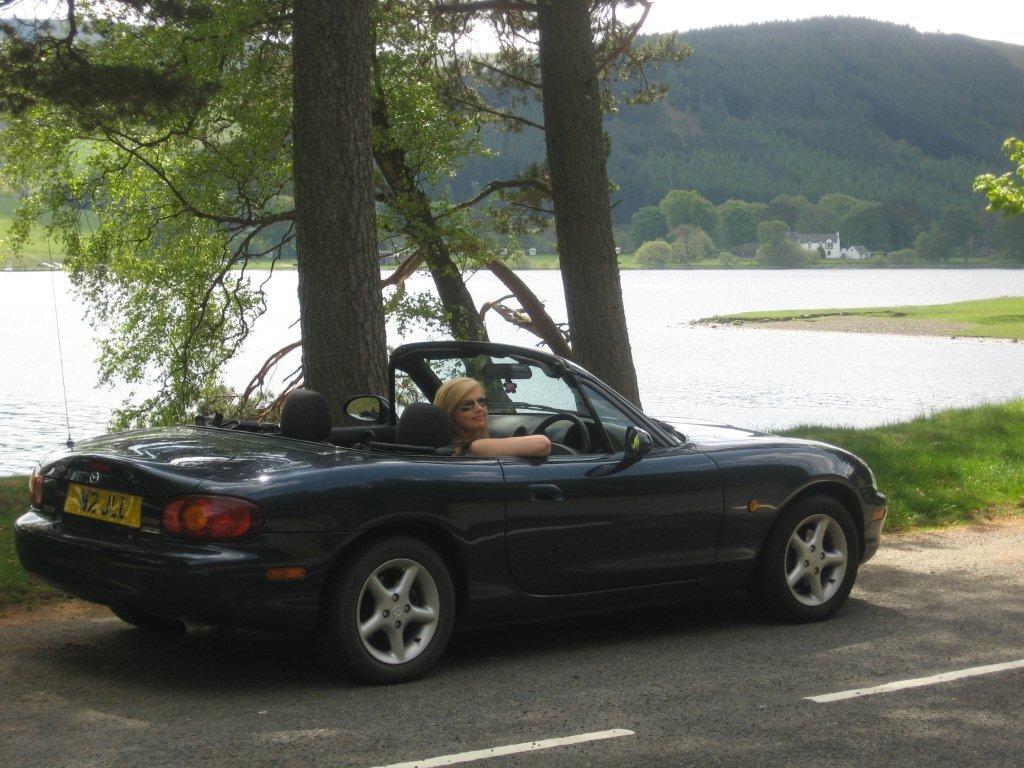
Today’s Thursday throwback features me and my beloved little sports car, taken about 10 years ago. The story behind the MX-5 goes back to when I was 21 years old and receiving 20 fractions of radiotherapy for my first lot of Hodgkin’s Lymphoma. At the beginning of my treatment, I had been feeling lousy. I remember halfway through my 20 fractions, lying on the table with the machine rotating around me and zapping me with invisible rays, and thinking that when I finally got better, or even cured, from all of this, I would buy a wee sports car to celebrate.
Well, although the radiotherapy worked initially, my Hodgkin’s Lymphoma recurred again four years later. However, I still maintained, during my chemo, that I would buy a wee sports car if or when I was finally cured. It was like a little pipe-dream to hold onto. A carrot in front of a bunny. A motivation to keep going. I would live a fun life when all of this was over, and not take things for granted any more.
In 2007, ten years after I finished my chemo, I was discharged from the hospital’s haematology department as I was cured from Hodgkin’s Lymphoma. And I got my little car. He was old (an old W reg) but he was my pride and joy. I washed him every week, and went out for spins in him every day. I even got a personalised number plate to claim outright ownership of him, in my mind. I used to love driving home from nursing shifts in the summer, along the country roads which connected the hospital to my home, with the roof down. We had such fun, my little Zoomzoom and me. Sadly, in 2015, we had to sell him as he was getting too expensive to maintain, but somebody else subsequently bought him and looked after him. I’m glad he didn’t get sold for scrap.
I miss that wee car, but am so happy that in the years I had him, I was able to fulfil the dream I’d had 15 years before. Will there be another Zoomzoom to celebrate being cured of breast cancer? Time will tell…..
Me and my Zoomzoom by St Mary’s Loch, Scottish Borders.
I have always loved learning things, and in particular, I have always loved reading. My parents used to tell me that ever since I could walk, I wouldn’t be seen anywhere without a book under each arm. By the time I was five, I was in the top reading group at school, reading well above my age level, and by the time I finished primary school, I was top in English, grammar, science, and maths and was (informal) Dux of my primary school (my teacher and headteacher told both me and my parents this, but actually she decided to formally award Dux to another girl in my class – who cheated at maths – because my class teacher didn’t like my handwriting! I am still bitter about it to this day, especially when people always compliment me on my handwriting…. Oddly enough, this was repeated later on with my Master’s degree – I was marked by two markers as having passed with Distinction, but then unexplainedly demoted by a third marker to a Merit despite my work having been graded ‘Excellent’ all down my marking sheet. Yeah, cheers for that. I wasn’t even allowed to appeal. Huh. Apparently, there were ‘too many’ Distinctions that year so mine went down a league. Even now I can’t look at my Master’s certificate without feeling cheated. However, ‘we move’ – as the youngsters these days say. I’m just so happy I got my Master’s, especially not having done a full English undergraduate degree).
I knew when I started senior school that I wanted to study English at Uni when I finished school. It was always my strongest subject, closely followed by Biology. I wanted to spend my life researching books and writing about books, and lecturing people about books. I applied to Edinburgh and Glasgow Universities for their English Language and Literature degrees (as they were in those days) and got accepted by Glasgow but rejected by Edinburgh (which, incidentally, was my dream university). However, to cut a long story short, I eventually turned down my place at Glasgow; they had a scarcity of accommodation, and I would have needed to have commuted in every day from Edinburgh which really wasn’t feasible and would be expensive financially and time-wise. As it was too late by then to apply for a space on another course that year, I spent my Gap Year as a nursing assistant in a psychogeriatric ward in order to earn some money and ‘experience’ the world a bit. I ended up loving this so much that I decided to ditch applying again for English, and instead applied for a nursing degree at the university which was literally seven minutes’ walk from my home.
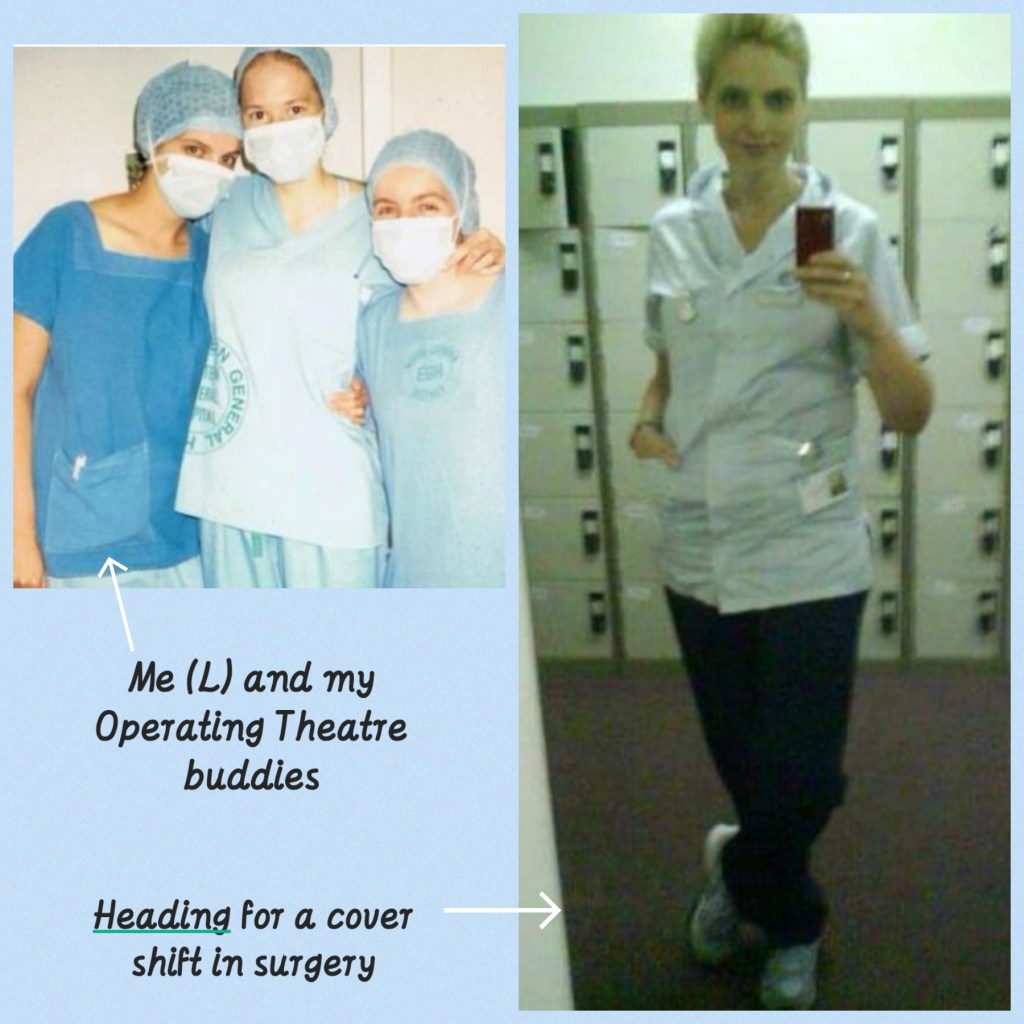
Me in my ‘last life’ as a nurse.
Fast forward sixteen years, and I had to medically retire from nursing due to my third cancer diagnosis. I loved my job – particularly in critical care – but there was no way I could continue. The long hours (usually working long shifts on days off too to cover for absent colleagues), minimal sleep between shifts, and the general low morale and excessive stress of the job took their collective toll on me. So, I had to think about what to do with my life. I was 41 years old – in my view, most people had their lives sorted by now, and here was me about to start from the bottom again. As my cancer treatment was lengthy and debilitating, one evening I made the bold move of enrolling on an undergraduate Open University English module (in the days you could just randomly apply to do any module you liked whether you were working for a degree or not). I was going to do this English study that I so desired when I was a teenager. I’ve written blogs on my Open Uni journey so won’t repeat myself suffice to say that I absolutely loved my studies so much that I enrolled on and completed a Master’s in English, also through the Open Uni. I have since been studying for my PhD at Edinburgh Uni (my dream university) where I am a-l-m-o-s-t finished writing my thesis. I have the best supervisor in the world and I am loving every minute of researching for my degree – well, mostly loving every minute. Let’s not gloss over the fact that it’s tough and there are days when impostor syndrome kicks in, self-doubt, and just general fed up-ness with my never-ending thesis.
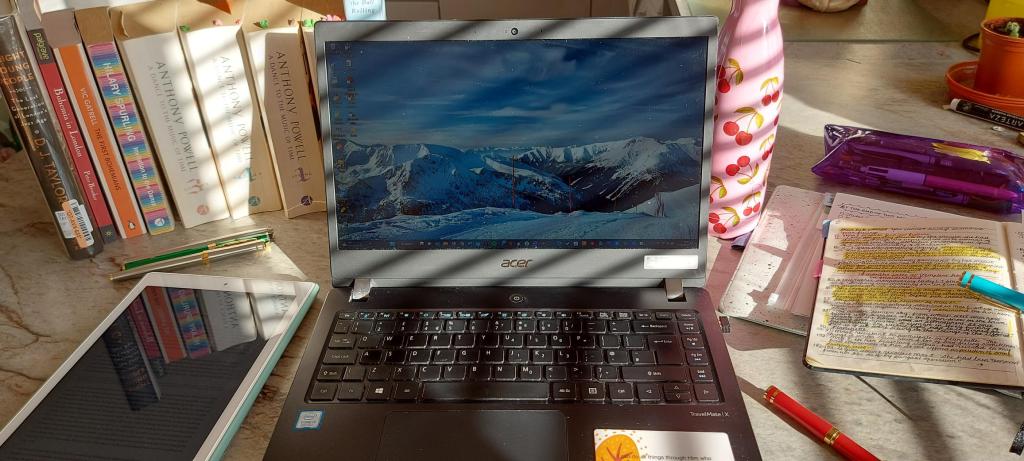
Only some of my PhD research tools!
I embarked on my part-time PhD when I was in my mid-40s, a time when my kids were all grown up and at Uni or finishing school and were increasingly independent. At the time, my parents were both well as was my mother-in-law, and circumstances seemed to continue as they had been throughout my Open Uni study. I had a wee office to hide away in every day at home (which I preferred to the open plan, distracting PhD office at the uni) – first year was a breeze. It was different though. I was the dinosaur of my cohort. It’s something I didn’t feel with online study as most people were about my age plus, learning remotely, you only really interact through formal forums or through dedicated Facebook groups. But I really noticed it on campus. The youngsters (all in their 20s) were all wanting to meet up to go out in the evenings, when I just wanted to go home, put my PJs on and just read with a hot chocolate. They’d all talk about their favourite music bands, and I’m thinking that I still remember the original version of the cover song they are talking about. Don’t get me wrong, they were (and are) a lovely bunch and never let me feel excluded, but when you feel that inside you are their age, but you’re actually not, it can be a little odd. I have to admit to feeling envious of those youngsters though and the fact that they were studying for their PhDs whilst they were in their 20s – they have a whole life ahead of them to follow their dreams, while I’m likely to be way too old by the time I finish mine to follow my own.
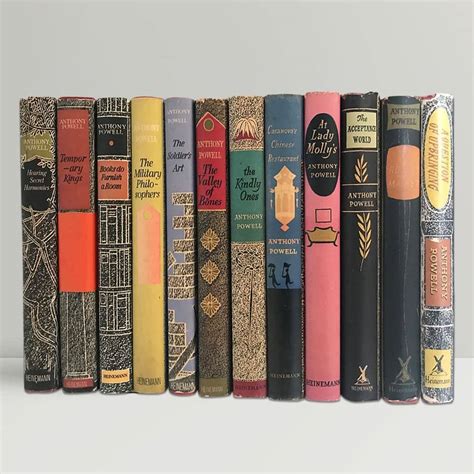
Powell’s ‘A Dance to the Music of Time’ series – I am writing my thesis on these wonderful books.
I presented my first conference at Oxford Uni in the late summer of 2018, and then – at the start of second year – everything seemed to go downhill. My Mum was misdiagnosed by her GP as having ‘swine flu’ but which, several months and a private CT scan later, turned out to be advanced metastatic breast cancer. Then my mother-in-law kept falling/fitting and going into hospital at six-weekly intervals. On top of this, my daughter was having a tough time with her mental health and, as a result of all of these, my PhD study took a major hit. I had to be daughter, daughter-in-law, and mother to these three women – there was no way I could focus on my studies. Any time I could focus, it was well into the evening – after tutoring my school students – when I was physically exhausted. So, on the advice of my supervisor, I took an interruption from my PhD study for 8 months. Being able to do take that break in order to be the supportive family member that I needed to be, was so great; by the time I returned to my studies just before Christmas 2020, things had calmed down – Mum’s cancer was being controlled well, mother-in-law had had her medication updated, and my daughter was at Uni (albeit under COVID lockdown). I felt mentally and emotionally ready to get going on my research again and so I set to on my second thesis chapter.
I had almost finished this when I needed to take another break a year later. Mother-in-law had fallen ill again on Boxing Day (from which she ultimately passed away two weeks later) and it was becoming more evident that Mum wasn’t going to be around much longer. The previous July we had received the news that her cancer had spread to her liver; by the December she was a skeleton of a lady and was really not well. So, I took another six months off so that I could spend Mum’s remaining weeks with her. She passed away at the end of February 2022. I was all for giving up my PhD then – I thought my supervisor would be frustrated with me, and fed up that I was still about, writing this magnum opus. I had had no focus for months and Mum’s passing hit me hard – reading anything was too much let alone books by my beloved Anthony Powell. I also thought of my full-time cohort, many of whom had already graduated while I am still stuck with only two out of three chapters written and no appetite to get back to it. But on the last day she had the ability to speak, Mum made me promise to see my studies through. She knew this was my dream degree, and she said she didn’t want her not being about to stop me finishing what I had started. So, I did promise her I would see it through – and I am, albeit at a pace akin to a snail as we now prepare our house for selling.
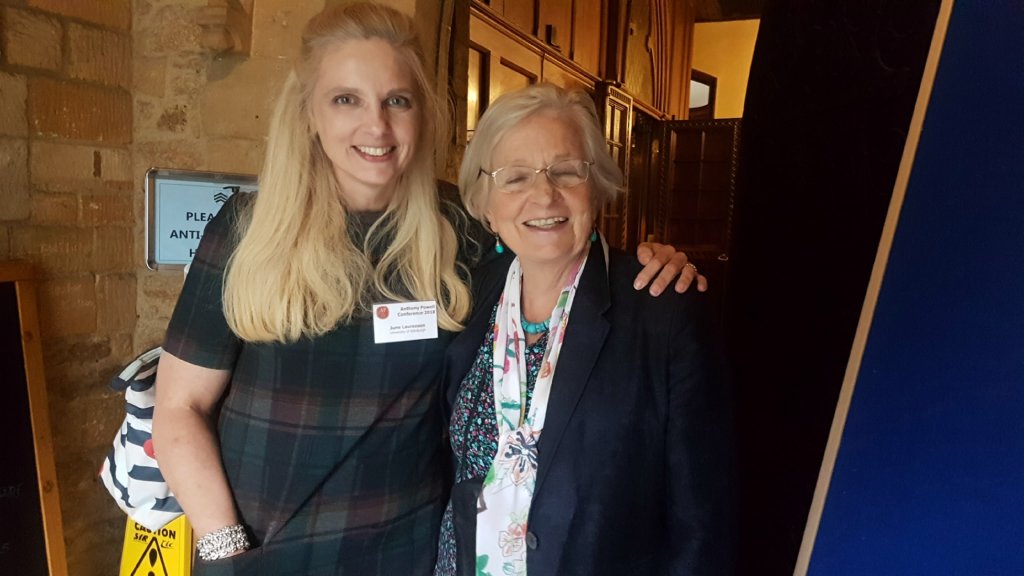
Me finally meeting the woman whose encyclopaedia of Powell’s ‘Dance’ novels is making writing my thesis so much easier – Hilary Spurling. She was the only author with whom Anthony Powell entrusted the writing of his biography.
Taking breaks during such big projects is absolutely OK. Researching for a PhD is a lonely business – unlike a school or undergraduate/Master’s university class where you have course-mates studying the same things as you. Add on top of this family issues, personal health issues, or anything else, then your standard of work is going to suffer. When I started my studies, I was determined I would finish in four years. A super-fast part-timer. But, life threw the kitchen sink (and the toolbox) at me and here I am, about to start year six, still plodding on. I’ll get there. I’ll do it. But I want to be well in the process. I presented my second paper at a conference last summer and got such encouraging feedback from it, that I remembered just why I am doing this research in the first place. Although I have had to take time out, twice, I would rather submit a thesis that I loved doing and is my very best work rather than plough onwards and feel that I resented doing it every minute. I’ve invested time, money, and energy into this – I’m going to make it count even if it takes me that little bit longer.
These are only some factors which make my PhD very important to me. Besides these, I love researching the author Anthony Powell (who, annoyingly, very few people have heard of) and finding brand new links that have not been connected before. I argue that he is just as effective a commentator of London society in the 1920s – 1970s as Charles Dickens was in the previous century. I have ambitions to teach a Powell course at the university – whether that be an evening class or by another means – and I have a post-doctoral research area all ready (if I am offered a place to study for this when I finish my PhD). My love of learning and reading that was part of my identity as a toddler still remains to this day.
This level of study does mean a lot of sacrifices – I am self-funding and so I have to pay the yearly fees, but my tutoring helps cover these. It means sacrificing some aspects of my free time or social life, but it is worth it. I am aiming to finish early 2024 – family health permitting. I want my almost 90-year old Dad to come to my graduation. I want to realise my teenage dream. The importance of my PhD to me is also because I’m not just doing it for me, or my late Mum, or indeed my family. I am also doing it for my supervisor (whose knowledge is inspiring), my friends at the Anthony Powell Society, (who have been so encouraging and informative), for my recently retired second supervisor, (who gave me such valuable feedback during the first two years of my studies), and also for Anthony Powell himself. Although he is no longer alive, I hope that my thesis will raise his profile a bit in the literary world so that more people can see for themselves the genius behind his writing.
This is quite a big thing for me, as I don’t think I sing very well. Indeed, the only time I think my singing is amazing is when I have my earphones in and I’m belting out lyrics along to whatever song is playing on my chosen Spotify playlist at the time. When I take the earphones out, oh dear. Poor neighbours.
It’s not like I am tone deaf – I can read music as I play the piano (and am learning the ukelele, but that’s another story). I just have such a wabbit wee voice that is as far from the strident tones of the singers I am accompanying. Their voices are powerful waterfalls, mine is a tiny rivulet. My husband has such a strident voice and so, as a result, I tend to keep my singing to the times when I am by myself and am certain that my neighbours are out.
However, I joined a choir. This was all down to a nurse at the local vaccination clinic, when I went for one of my COVID boosters. We got talking about why I am deemed high risk, and I mentioned my faulty lung (one of my lungs has a degree of fibrosis/scar tissue as a result from it being a site for one of my lymphoma tumours). I mentioned how, at times, I find it hard to breathe properly; my peak flow measurement is absolutely pathetic! She then suggested I should join a choir, as the breathing techniques required in singing may well help with my breathing issues. I said to her that people would pay not to hear me sing, but took her advice on board, and thought it over.
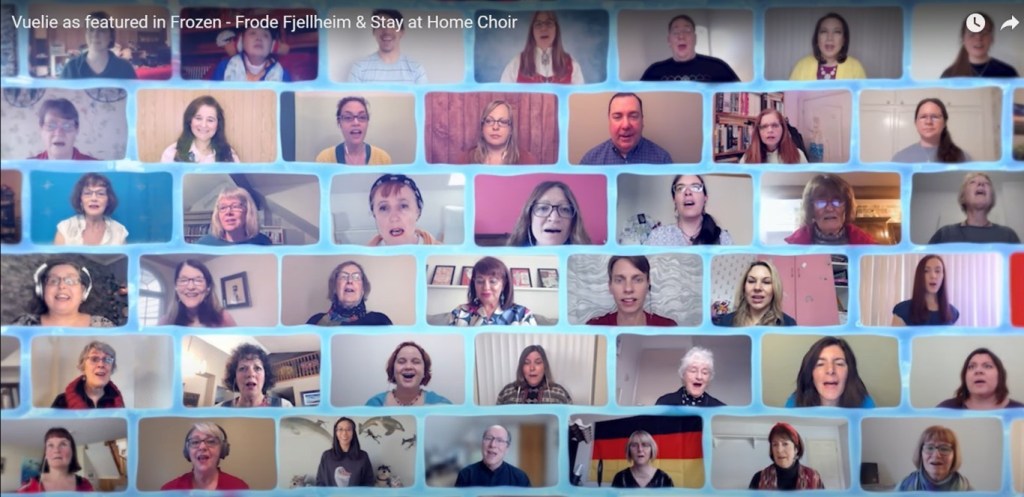
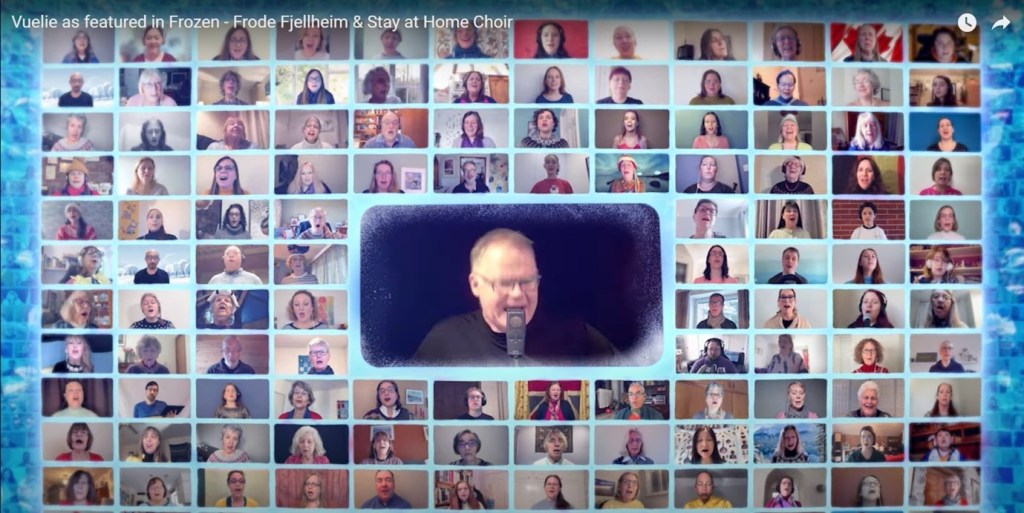
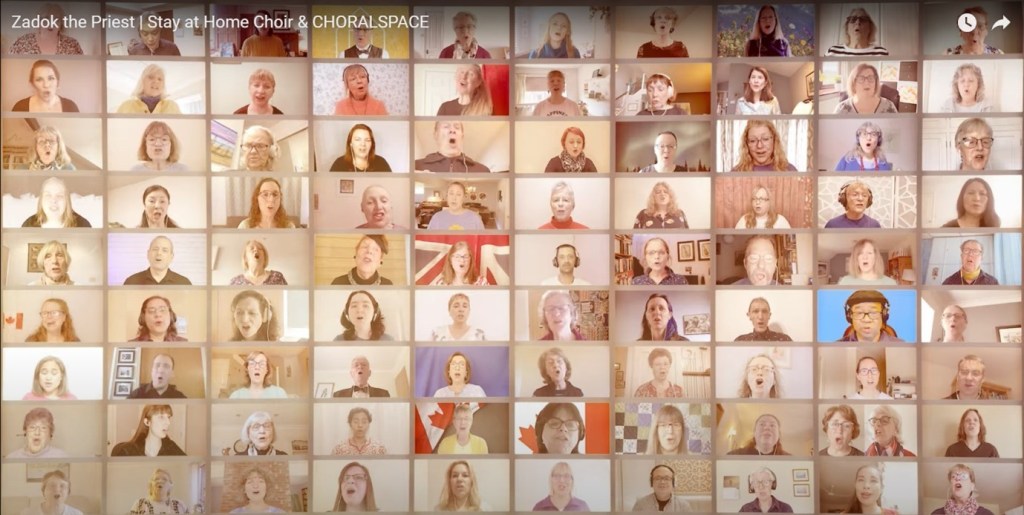
My husband had joined the Stay At Home Choir during the pandemic lockdown, and had sung some amazing pieces with them. What happens with this is that you download the score for the pieces you are singing, have tutelage and rehearsals online via Zoom, film yourself singing your part, and then send it in via a special portal on the SAHC project page. After a few months, the people behind the scenes compile a Youtube video featuring every single person who participated – and the sound is amazing! So you’re in a choir, but you can rehearse, record, and submit your piece without being in danger of someone picking you out for singing something wrong. What is even nicer is that the members of the choir come from all corners of the globe!
So, I joined the choir last January, and tend to sing Soprano 2. So far I have participated in four projects: one which involved Norwegian ‘yoiking’ with composer Frode Fjellheim: https://www.youtube.com/watch?v=avCgULB3UIY
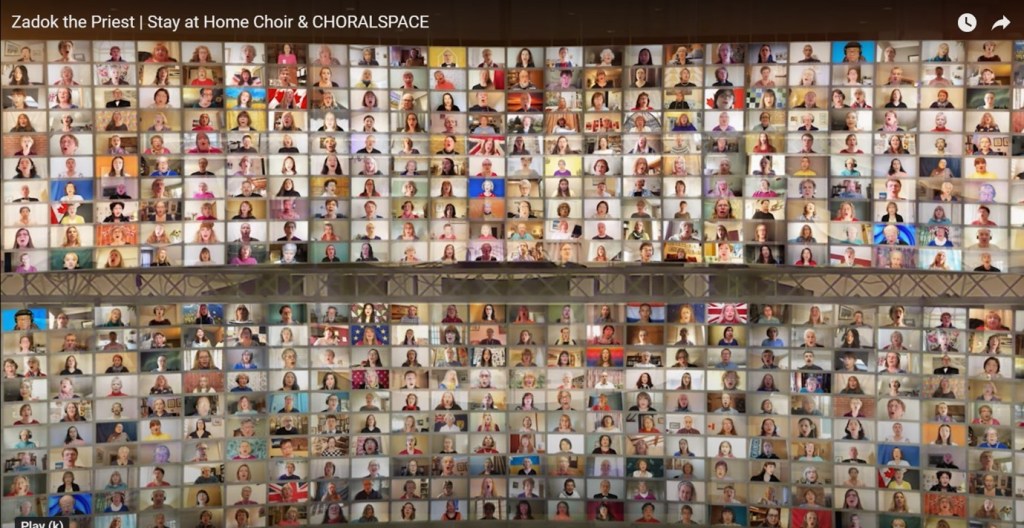
I have also sung Handel’s ‘Zadok the Priest’, a recording which was subsequently dedicated to the memory of the late HM Queen Elizabeth II: https://www.youtube.com/watch?v=1wz9oazzWjQ
Can you see me?
My latest project was participating with the choir in singing Thomas Tallis’ ‘If You Loved Me’. This is due for release on Valentine’s Day, and I will post the link here when it is available. It was a beautiful piece to sing, if a little complex!
Next up, we are singing Christopher Tin’s ‘Baba Yetu’ – one of my favourite songs. Rehearsals start next week, and I am so excited for them!
And finally, I have also sung with the choir in two pieces which will be included in Karl Jenkins’ forthcoming album ‘One World’ (released in the summer). Karl Jenkins is my favourite modern day composer (I have all of his Adiemus albums) and so being able to participate in singing two songs for his new album was so thrilling!
All of the pieces that the choir have sung prior to my involvement can be found on the SAHC Youtube page. They are all wonderful pieces of music – two led by Gareth Malone were especially written for the choir to perform.
Now, I am loving singing and I don’t care who hears me rehearse! I think it has even helped my breathing a bit too. I still think I would hesitate joining a real-time choir though…….. I need a bit more confidence for that! If you have been reading this and are interested in signing up for future projects, keep an eye on the SAHC webpage. Then you, like the rest of us, can enjoy the music you have produced whilst searching for your own wee box on the screen when it is released on Youtube!
I have been thinking about this subject over the past week in preparation for this blog post, and it has been quite tough to choose one thing over the past (ahem) 50 years which, to me, has been the most important (to me) invention. Since the 1970s, we have seen the emergence of the mobile phone, the internet, more sophisticated computers, online shopping, ATMs, CDs and DVDs (now eclipsed by Blue-Ray discs), MP3s, eBooks, and automated machines which can tell you everything from the news headlines to playing a favourite song just by the sound of your voice wakening it up. Life in the 2020s seems to be more ‘plugged in’ than I can remember it as a child and I’m not necessarily sure if this is a good thing.
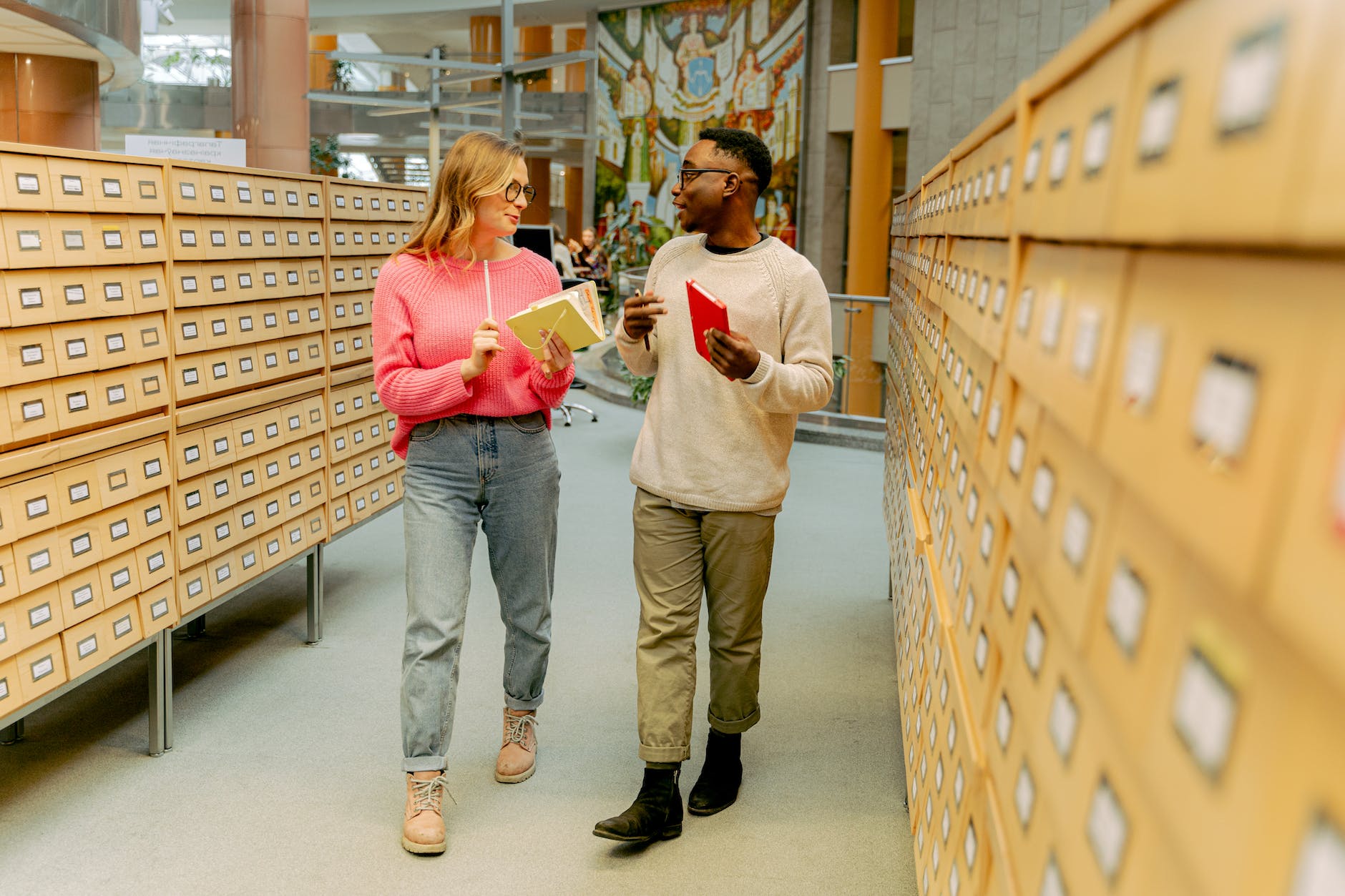
Yes, I have multiple Spotify playlists which I listen to on a daily basis – probably listening to music through this platform more than actually putting one of my hundreds of CDs into my CD player. But that’s because it’s more convenient. And, although I still have a CD Walkman, carrying that about when I’m exercising outdoors isn’t really practical. Yes, I’m writing this blog on the internet (more out of wanting to document my thoughts as my reach with this blog is pathetically low), and I do get some shopping online. It’s very different studying for degrees nowadays than it was when I was a nursing student in the 1990s; to write essays we had to scour little drawers in the library to find the particular article we wanted and then, armed with that info, you went in search of the journal or book. Tough luck if someone else had it out on loan/borrowing it at the time. It was even more fun when your whole year group was writing the same essay – 30 people trying to gain access to one article was a bit like trying to be first into the January sales!
Nowadays, libraries have everything a log-on away. Everything is a lot more instant – which can only be a good thing, right? Social media means that you can have immediate conversations with people you have never met on the other side of the globe (or even in your town) – surely that has to be good for loneliness? Personally, I am weaning myself off social media – I very rarely use my Twitter account any more (it’s too full of celebrities seeking the most followers/validation and such like. I’m going to be deleting that platform soon), and I am rarely on my Facebook. Instead of easing loneliness, it actually makes me feel worse. When I see people who I thought were friends meeting up for events that I haven’t been invited to, or someone I know ‘unfriends’ me [once a real-life acquaintance who I had known for 30 odd years blocked me on Facebook because I wished her a happy anniversary. Ehhh?? By the way, she was still happily married to the same man so what was that about?], or I am forced to see the wondrous evidence of everyone else’s perfect lives (or so they like to depict them), it makes me feel inadequate, sad, and that I’ve done something wrong. Have I said something to make people not like me and not want to be friends with me? Why isn’t my life like that? And why is it that people who ‘cut you dead’ when you see them in the street ask to be your Facebook friend? It’s all a bit beyond me, I’m afraid. So, I keep my Facebook and Instagram use to the bare minimum and am hoping to purge myself of them completely within the next few years.
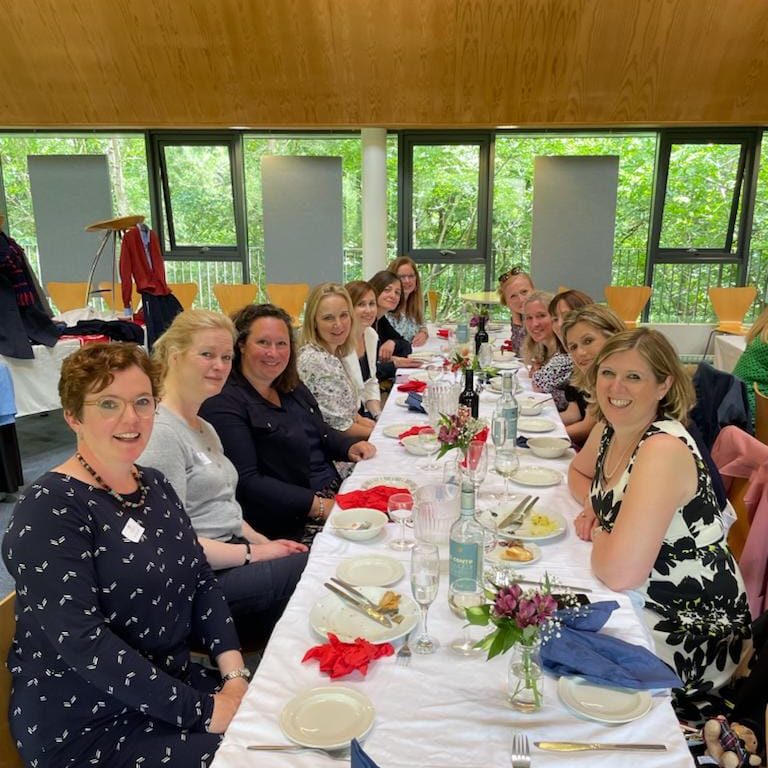
St George’s, Edinburgh, Class of 1990 ‘Belated’ Reunion: June, 2022
But, on the flip side, social media has helped me gain contact with a lot of my old school friends (I loved my school days) and I enjoyed a wonderful reunion with them all again last summer. I have also met some remarkable people who have helped me raise shedloads of cash for charity that little introverted me would never have managed to raise by myself. Additionally, over lockdown, being able to go online (Youtube) to join the services from our church gave a form of constancy and much-needed solace. I do think, though, that social media can never replicate actual face-to-face conversations. I do enjoy hearing news of people directly from them in person, seeing facial expressions, etc, rather than impersonally over the web. Same with shopping, I’d much rather go into a shop and buy things rather than get them online; the latter seems so impersonal. I prefer to live ‘in the moment’ and enjoy real life around me than to live through what I see on a screen. So, although the internet is good for some things, to me it isn’t the greatest invention of my lifetime.
Mobile phones – again, I could quite happily live without mine. I am slowly downgrading the type of phone I have and am wanting just the basic remodel of the Nokia 3310. I only have one friend who calls me (I know – I seem not to have many close friends just now!) but otherwise I only use it to call my Dad, or to make appointments. I don’t need the internet on the go, although Google Maps is useful sometimes when I get lost (a frequent occurrence!), as is Spotify (for listening to music on the go. I’m not really a podcast person). When waiting for a bus, or an appointment, nearly every other person waiting has their phone out and are aimlessly scrolling. Meanwhile, I whip the book I have brought along with me out of my bag. I’d rather hide in some quality fiction than in the fiction of social media!
Talking of books – eBooks. Now, I have numerous Kindles. I have about 1000 books on them (most stored on the ‘cloud’). My Kindle is great for taking on holiday when I’m scared I might run out of reading material, or for reading during the night when I can’t sleep. But, there is nothing that beats a physical book. So, I could live without my eBook reader – I would just have fewer books.
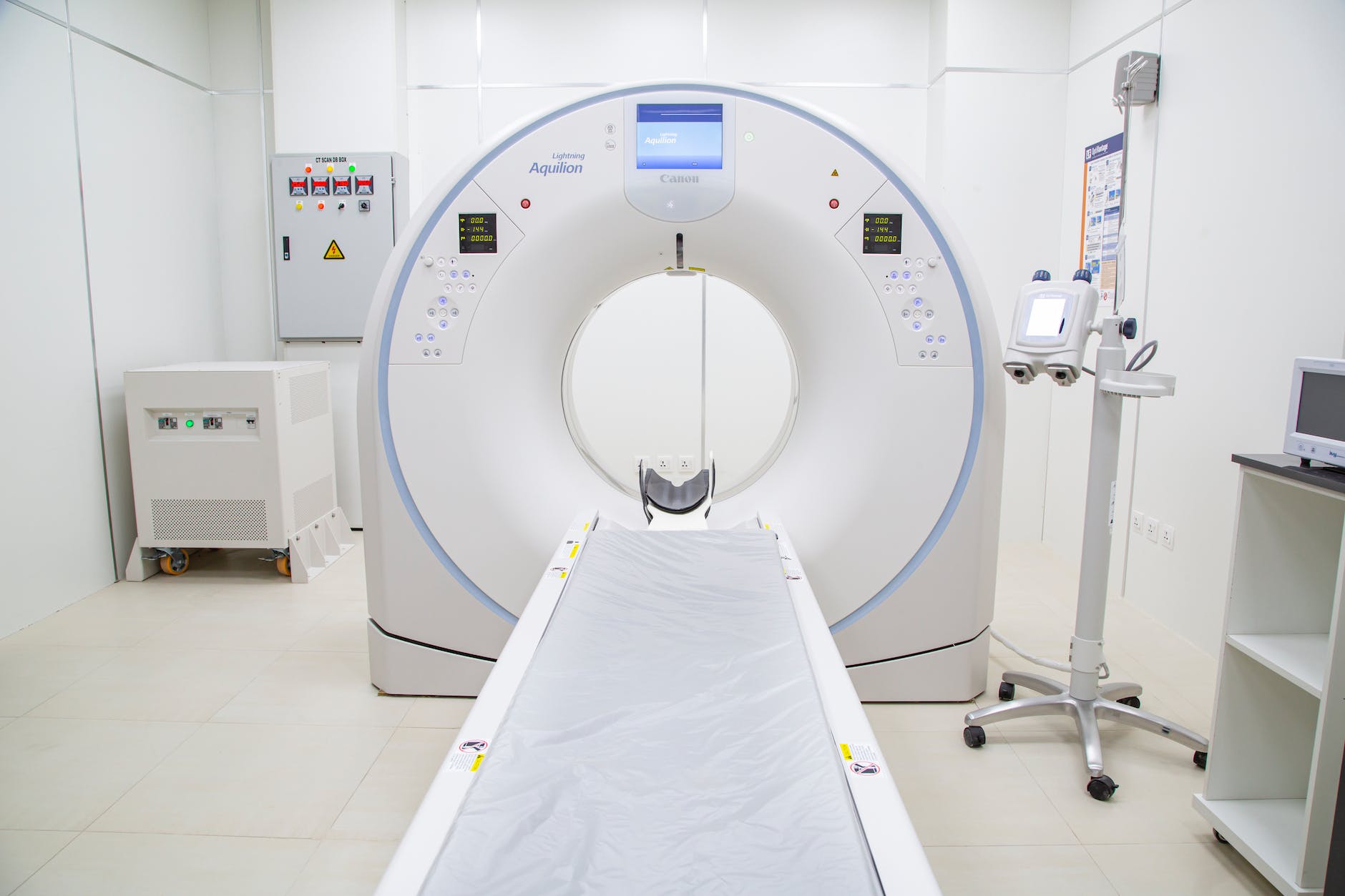
So, what is the most important invention in my life-time, in my opinion? I think it has to be the advances in the medical world, particularly the invention of the MRI (imaging machine). Cancer can now be cured, or better controlled, and so many new procedures (such as laparoscopic surgery) have meant that fewer people have to have open surgery for appendicectomies or for gall bladder removal, etc. Due to my extensive medical history, I have had so many CT scans that I am not allowed any more in my lifetime. Instead, I have to have MRIs. Indeed, without my latest MRI, the cancer I had would not have been diagnosed so accurately. They’re noisy brutes – I wasn’t even offered earphones or music for mine – but extremely effective. And what is more important than diagnostic tests to enable individuals to get effective and prompt treatment for their illnesses? I am hoping that I won’t need any more scans – but should it be necessary – I will be indebted to Paul Christian Lautebur. Without his invention being trialled in the medical field, in the year I was born, I wouldn’t be here now. And nor would many millions of others.
So, three cheers for medical advances and, especially, Magnetic Resonance Imaging. The one thing in the past 50 years that I literally could not live without.
If anyone is reading this blogpost, it would be interesting to know what you consider to be the most important invention that has emerged in your lifetime.
So, I’m going to start a short weekly series where I write a very short blog about the things which mean the most to me in life. As tomorrow will be 11 years since my second of three cancer surgeries, today I am going to focus on health, but subsequent months will include my Christian faith, my family, my PhD, happiness, my extensive book collection, music (particularly my love for everything from Iron Maiden to Mozart), charity work, my community (particularly my wish to support those going through tough times), and things like that.
Today, though, we are finally at the last day in January. Man, it seems to have lasted for-e-ver. I’ve mentioned on social media in the past just how much I dislike January and February, so to have got through one of these months is at least something! In relation to this post, though, 1st February sees my 11th anniversary of the middle cancer op I had – a little victory – before the biggie in June 2012. But, I’ve blogged all about it before – you can find posts about it in the Alternative About Me category on my page. —->
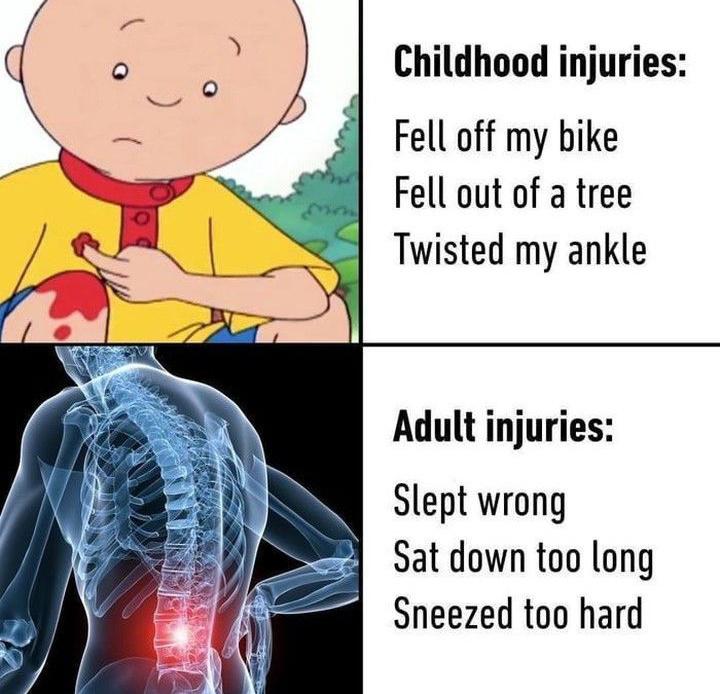
It seems appropriate, therefore, that today I celebrate the fact that, 11 years on, I am in very good health. Yes, I have aged and am not quite as agile as I used to be. Yes, getting up out of the sofa sometimes needs a second attempt. Yes, the grey hairs are becoming more plentiful (but thanks to my amazing hairdresser are not often in evidence). And yes, the old visage contains a lot more lines. But instead of shying away from growing older, I have learned to embrace it. What does it matter if I’m 51 years old, but I’m actually still 21 at heart? I think after having the three cancer diagnoses I have had in life, it really does put another perspective on life; I’m actually really blessed to still be here, so I’m going to celebrate that fact!
Source: r/memes SHUBHi2024
I am very conscious to follow a healthy lifestyle, although I’m the kind of person who only needs to look at a cake and put about 5lbs of weight on. After a few years of basically being a slob (mainly thanks to COVID lockdowns and a sedentary job writing my thesis), I now practice Intermittent Fasting, which has been brilliant for me physically and mentally – I feel much sharper mentally, my energy levels are on the up, and my jeans are loose again (woohoo!). I started off with the 16:8 programme, but am now up to 20:4 (most days – the odd day I will slacken a little). I now feel that I can sit for extended periods and research/write my thesis; prior to this I was struggling to concentrate. My resting pulse has come down by 7 bpm within the last month and, overall, I’m feeling great. How long I will continue this for, I don’t know, but at the moment it is helping me a lot. A feeling-good June is a happy June.
I don’t drink alcohol, nor have I ever smoked, but I do take very regular exercise, walking the dogs (who may be tiny, but boy they walk fast!), climbing the numerous hills in the town where I currently live, and bonding with my rowing machine – which has been the best investment we have made. As I’ve written before, I am allergic to sport, although I like watching other people doing it. I’ve injured myself running: my knee dislocates all the time so things like tennis are out of the picture too, team games scare me, cycling on open roads freaked me out so I stopped doing that, mountain biking is…… no way Jose……, and I can’t swim (my parents did take me to swimming lessons when I was a child, but I never took to the thought of being in water with other people whose hygiene may not be the best. Plus the co-ordination needed to move arms and legs at the same time was, well, beyond me). Despite this reluctance to do anything other than walk or row, I still manage to average about 13K steps per day, even if sometimes I end up doing laps around the house to increase the number on my fitbit (or wave my arms a bit……ssssssshhhhh don’t tell!). However, I do find exercise tricky; although I am fit, I do get breathless very easily because I have fibrosis/scar tissue in the lung which was affected by HL and it doesn’t function as well as it should. It’s really frustrating. When I am at the University and have to go to the 12th floor of DHT, I make myself take the stairs. I’m a wheezing wreck at the top, but you get the best views from the stairs! I just need a few minutes to sort the breathing out, and then I’m fine. There have been times when I have had to stop a gym workout through breathlessness and light-headedness but again that clears after a few moments. My usual saying whilst recovering from strenuous exercise is “Just give me a minute”. It’s one of the legacies of my medical history that I just have to live with.
I’m determined that I am not going to get a fourth Big C diagnosis, and thus am trying everything I can to be able to “grow old gracefully”. I want to be a “cool granny” one day. Medical research is so important – not only I have benefitted from it, but many people I know have as well. Diseases previously considered to be fatal now may not be, thanks to these clever people who spend their days working in labs striving to find effective treatments for everything under the sun. In my days as a pharmaceutical research nurse I could see this for myself – so many medicines are produced for everything you can think of. Some work, others don’t. But without this knowledge, middle-aged me wouldn’t be here now, sipping at my tea, and contemplating getting a sweetie from one of the boxes I got for Christmas. I will go into medical research more when I talk of why charity work/fundraising is important to me, on another Tuesday.
So yes, keeping healthy is important to me. Every day I am thankful that I can walk about, go out, and feel well. I trust things stay this way for a looooooong time! Here’s to good health.




 June's Jottings